
 Buy
Buy Sell
Sell Exchange





Omega
Why Does NASA Use Omega Speedmaster Watches?
Apr
When people talk about Omega and NASA, the Speedmaster is usually the first thing that comes up. It’s often referred to as the “Moonwatch”, a nickname that dates back to the Apollo missions of the 1960s and 70s. But what makes the relationship interesting is that it hasn’t stayed in the past. More than 50 years after the last crewed Moon mission, Omega watches are still being used in space.
In April 2026, the astronauts aboard Artemis II began their journey around the Moon wearing Omega Speedmasters, continuing a connection that stretches back to the earliest days of human spaceflight. Understanding why NASA chose Omega in the first place, and why it still relies on the brand today, gives a clearer picture of what the Speedmaster actually represents.
How Omega Became NASA’s Watch
In the early 1960s, NASA needed a watch that astronauts could rely on in extreme conditions. Rather than selecting a brand based on reputation, the agency purchased several chronographs anonymously from different manufacturers and put them through a series of rigorous tests. These included exposure to extreme temperatures, shocks, vibrations and pressure changes.
The goal was simple, the watch had to function reliably in environments far beyond normal use. Out of all the watches tested, the Omega Speedmaster was the one that met NASA’s requirements. In 1965, it was officially qualified for use on all manned space missions, this wasn’t a marketing decision – it was the result of a technical evaluation.
Learn More: Omega & Nasa: Space Legacy
The Moonwatch and the Apollo Missions

The Speedmaster became widely known during the Apollo program, particularly in 1969 when it was worn during the Apollo 11 mission, the first time humans set foot on the Moon.
From that point on, the watch became closely associated with space exploration. It wasn’t just worn during Apollo 11, but across multiple missions, including Apollo 17 in 1972, the last time astronauts travelled to the Moon. That connection is what led to the “Moonwatch” name, and it remains one of the strongest associations between a watch and a real-world event.
Omega and NASA Today: The Artemis II Mission
The Artemis II mission marked the first crewed journey towards the Moon in more than five decades. Astronauts Reid Wiseman, Victor Glover, Christina Koch and Jeremy Hansen set off from Kennedy Space Center on a 10-day mission, orbiting Earth before travelling around the Moon and as expected, Omega watches were part of that mission.
All four astronauts were issued Speedmasters from NASA’s equipment supply, continuing a long-standing tradition. But the specific model they wore reflects how space travel, and watches, have evolved.
The Speedmaster X-33: A Modern Tool Watch for Space
Rather than wearing the traditional mechanical Speedmaster Professional, the Artemis II crew were equipped with the Speedmaster X-33.
At first glance, it looks quite different. The X-33 is a quartz-powered watch with a digital display, designed specifically for modern space missions. It was originally developed in the late 1990s with input from astronauts, including those involved in earlier Apollo missions.
Its functionality goes well beyond a standard chronograph. The watch includes multiple timing functions, alarms and mission-specific features designed to operate in high-noise, high-pressure environments.
While it was discontinued for public sale in the mid-2000s, NASA has continued to use and maintain these watches internally. That continued use says a lot. In an environment where reliability is critical, the X-33 has remained a trusted tool.
Read More: British GQ – The Artemis II astronauts are wearing a twist on the classic Omega Moonwatch
Why the Moonwatch Still Matters
Despite the use of the X-33 in modern missions, the classic Speedmaster Professional still holds a unique position. It remains the only watch officially qualified by NASA for extra-vehicular activity, meaning it is approved for use outside a spacecraft, including spacewalks and potential future lunar surface missions. So while the X-33 is used inside spacecraft, the original Moonwatch still has a role to play.
If astronauts return to the surface of the Moon during future Artemis missions, it is likely that the mechanical Speedmaster will be worn once again.
What This Means for the Speedmaster Today
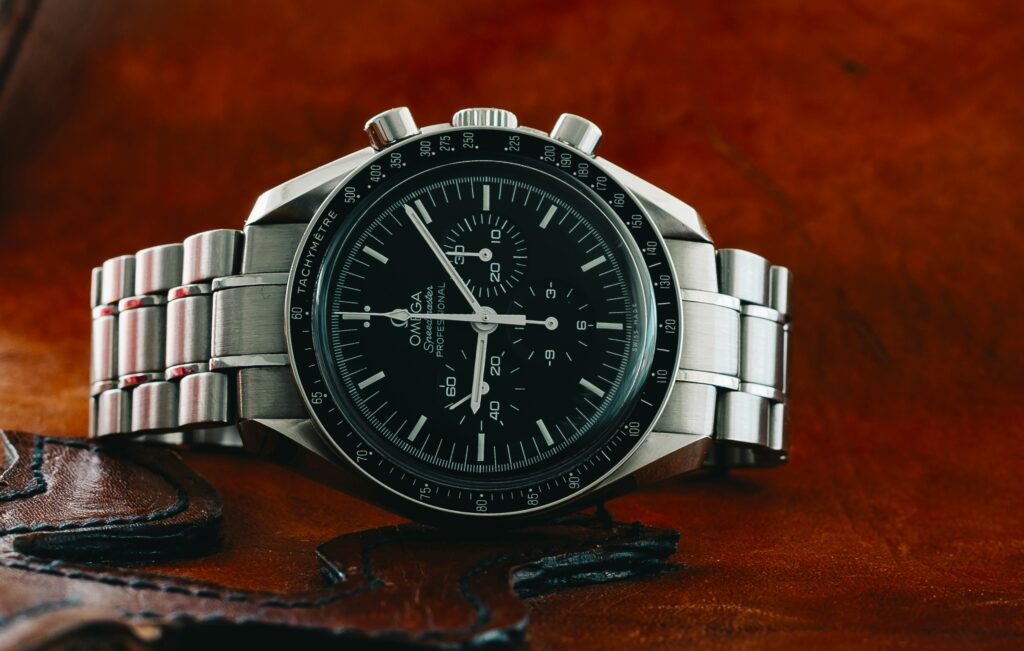
The connection between Omega and NASA is often talked about in terms of history, but it is just as relevant today. Few watches can point to that kind of continued use in real-world environments and the Speedmaster is not simply a design that references the past, it is part of an ongoing story.
For buyers, that doesn’t necessarily change how the watch functions day to day. But it does add context. It explains why the design has remained largely unchanged, and why the watch continues to appeal to those who are interested in something with a clear sense of purpose behind it.
Trotters Top Tip: If you’re considering a Speedmaster, it’s worth looking at both modern and earlier models. While the core design has stayed consistent, small differences in case size, dial layout and movement can affect how the watch feels on the wrist.
Buying a Pre-Owned Omega Speedmaster
The Speedmaster is widely available in the pre-owned market, with a range of models covering different production years and configurations. At Trotters Jewellers, we source and sell pre-owned Omega Speedmaster watches with a focus on clear presentation and accurate condition descriptions. Each Omega watch is inspected before being listed, so you know exactly what you’re buying and all watches come with a 12 month warranty and are available to purchase securely online, with fully insured UK delivery.
About the Author
Written by the Trotters Jewellers team, specialists in pre-owned luxury watches and certified diamond jewellery since 1991, based in the City of London.